
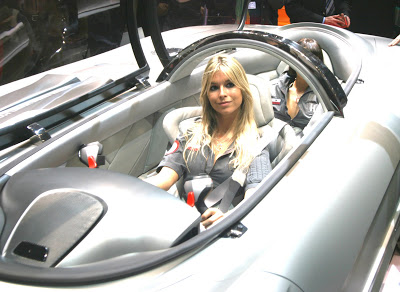
The Japanese also selected Frankfurt to display their latest concept cars instead of next month’s Tokyo motor show to which they will be shipped as soon as Frankfurt closes its doors.
Daihatsu’s arch-shaped electric hybrid follows the logical pattern for an electric car, until battery technology catches up with petrol as a convenient means of storing energy. The Dash 21 uses its own power plant to generate electricity. A 660cc three-cylinder petrol engine at the front starts up when the batteries stored under the floor run low.
The nickel metal hydride batteries have a better performance than lead acid batteries, and Daihatsu believes that they would last the life of the car. The enormous cost of battery replacement – a penalty equivalent to heavy fuel consumption on an ordinary car – has inhibited the development of electric propulsion.
Burning a lean mixture of petrol and air would make the Dash 21 very economical, and with a top speed of 75mph and a range of 280 miles, it looks like a realisable production possibility. Some restyling might be necessary.
The ESR (Ecological Science Research) Mitsubishi also pursues the hybrid route. Electric motors provide the motive power and the batteries are charged by a novel petrol engine which runs at a constant speed. A four cylinder of 1.5 litres, its even speed enables ultra-low exhaust emissions and a thermal efficiency, which Mitsubishi claims is superior to a diesel.
Nissan shows two concept designs in Frankfurt, the AP (Attractive Performer) – X and AQ (Ambition with Quality the Japanese have a way with names) – X. AP-X has a lightweight V-6 engine and a new kind of stepless automatic transmission. AQ-X is a rather disagreeable-looking four door saloon which has a smooth front and a flat underbody to achieve good airflow.
Ford has gone for a bulbous look in its Sub-B compact, which has a two-stroke engine serving as a reminder that a fleet of two-stroke Fiestas has been undergoing a user-evaluation programme. The tall narrow configuration, Ford says, is the best one for giving the occupants most space. The Sub-B is more compact than a Fiesta, with a sliding door on the right which gives access to the rear seats.
The rear-mounted 1.2 litre engine develops 82bhp and would give the Sub-B a fuel consumption of well over 50mpg.
END
General Motors revealed the engaging shapes of concept cars based on the Vauxhall Corsa. Officially shown to gauge public reaction, they had a maturity that suggests they are closer to production than GM is willing to admit. Indifferent sales of the Opel Corsa in Germany probably hastened their appearance to stimulate interest.
Called the Tigra, Roadster and Scamp, they looked too well finished to be mere flights of the design department’s fancy, and seem likely to be in production within the year. The Tigra is well proportioned and good looking despite its short wheelbase and since the Corsa is brisk and handles well, so the Tigra ought to have a performance to match its appearance. The open-topped and recreational derivatives also look the part, and will fill market niches in a segment where a good deal of the opposition is staid.
The Tigra’s big glass canopy carries the stamp of the accomplished design studio set up at Opel by Wayne Cherry before he was taken back to Detroit to revive GM’s lacklustre home products. The Roadster is a pert two seater that promises fun at an affordable price. It may not be a sports car, – it has leather-trimmed seats and stowage space for a cool box – but with close-ratio gears, power steering, and anti-lock brakes it promises to be lively.
The engine is GM’s latest ECOTEC 1.6 litre 16-valve unit giving 109 bhp, which provides a top speed of about 120 mph, and acceleration to 60 mph within the 10second benchmark that distinguishes the lively from the leisurely.
The same level of performance is promised by another handsome newcomer, the Civic coupe made in Honda’s American factory at East Liberty, Ohio. Cleanly styled, beautifully made and coming to Britain in February at less than £10,000 with a 1.5 litre engine, it is similar in size to the Vauxhall Calibra, Nissan 200SX, or Rover 200 coupe but a good deal cheaper. It will also be cheaper to insure and run.
There will be two trim levels, the ESi has power steering, central locking, four-speaker radio-cassette player and tinted glass. The LSi adds a sun roof, electric windows and a wide range of optional equipment including leather upholstery, alloy wheels and air conditioning.
The German motor industry is desperately anxious to regain its customary self-confidence. Sales are down 20 per cent on last year and some of the exhibition halls had unlet space. Frankfurt was a gossipy place for the 55th IAA motor show, full of rumours about the running war of words being waged between Volkswagen and Opel over the Piëch and Lopez affair. German industry opinion is about evenly divided on whether Piëch can survive when Lopez goes.
The Fiat Punto and the Toyota Supra, already on sale, were on public show for the first time, together with the latest Porsche 911 which, although it looks much like all the 350,000 other 911s made in the last 30 years, has been altered a great deal. Yet another new suspension will help with its out-of-balance rear-engined handling.
Porsche AG will manufacture the Audi Avant RS2, which made its debut at Frankfurt. An estate car based on the Audi 80, it has a turbocharged 2.2 litre engine giving 315bhp and a top speed of about 162mph. With acceleration to 60mph in 5.8 seconds, the RS2 is aimed at sports car drivers who have had to give up two-seaters. Production starts next year and only 2,000 are planned for 1994 and 1995.
America used to export large numbers of cars to Europe, in the days before General Motors and Ford established their own plants, much as Nissan and Toyota have now. Chrysler has rediscovered a commitment to export to Europe, stressed by chairman Bob Lutz, at the unveiling of the new Neon. This took place in a Frankfurt exhibition hall made up to look like a rather tacky pin-ball table, and in a noisy introduction Lutz revealed a Ford Mondeo clone, which will not go on sale in the UK. Chrysler’s commitment to Europe apparently does not extend to cars with right hand drive.
British exhibitors had their tails up following an apparent rush of sales in August, although Geoffrey Whalen, President of the Society of Motor Manufacturers and Traders, cautioned against a euphoric view of the UK market. “Our manufacturing industry depends heavily on sales in Europe, and our economic recovery is bound up in Europe’s economic recovery”.
Rover alone is inceasing sales in a declining European market – thirteen per cent up, it will sell more cars this year than Mercedes-Benz and only a few hundred fewer than BMW. Land Rover has had such a strong response in Germany to a special edition Discovery with chrome accessories, fancy wheels, and finished in British racing green, that it has had to make a fresh batch.
If she comes with the car, can I order two?
She didn't for me…