
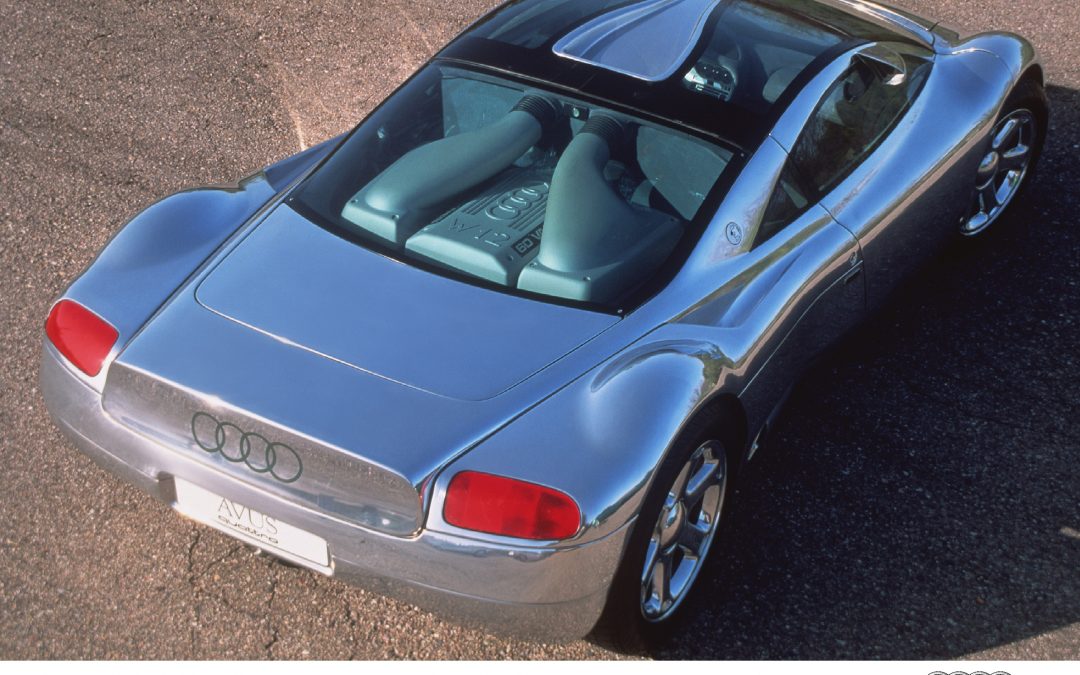
Aluminium Audi A2. A car for a lifetime’s motoring. 1992 Aluminium Audi Avus concept car shown at Tokyo.
Polishing motor show cars is a round-the-clock affair. This year at the NEC Jaguar showed its new XJ in its unpainted aluminium glory. It fairly gleamed in shining silver. Jaguar admitted it had put a special gloss on it following Audi’s example with the aluminium A8 at 1993 Frankfurt. Shimmering with innovative silveryness, the A8 was not Audi’s first aluminium show sensation. That was at Tokyo two years earlier, when it buffed up its spectacular Avus quattro coupe to show the Japanese that vorsprung durch technik was alive and well in Europe.
By the time Audi wheeled the Quattro Spyder on to the stand at Frankfurt the polishers were given a break. The aluminium was hidden behind a coat of yellow paint. It was 1993 before there was a production aluminium saloon, the ASF Concept that evolved into the 1994 Audi A8, followed by the nimble and clever A2 which went on sale here in 2000.
By this September Audi had made 200,000 aluminium cars and now Jaguar is joining the club with the XJ, looking much like the steel one it replaces but a good deal lighter. It will never rust and with manufacturers threatened with paying for their cars’ eventual disposal, it has the virtue of being completely recyclable. Aluminium is less easy to repair after accidents, particularly modern load-bearing aluminium but new means are on the way.
Aluminium cars are as old as the industry. It was the preferred material of the old coachbuilders, hand-beaten round ash frames, coated lavishly with layers of varnish. Sports and racing cars were made in aluminium but in small numbers. Production cars wholly of aluminium without steel or wooden reinforcement were rare. Rover had one in 1904, with an aluminium backbone casting rather like a modern agricultural tractor. The Autocar said, “As ordinarily understood there is no frame to this car and the engine, gearbox, propeller shaft casing and exhaust box, together with the rear axle, run continuously from front to rear in a deep box-section.”
Rover tried aluminium again in 1945 when steel was in short supply. Ironically there was plenty of aluminium. Scrapyards were full of shot-down or redundant aircraft and Rover made six prototypes of the M-type with lightweight castings before abandoning the project and introducing the Land Rover. This had bodywork largely made from aluminium.
One outstanding aluminium car was the French Panhard, the 1954 Dyna, which used the material for floor-pan, body sills, roof, and doors. The unitary shell weighed only 100kg (220lb), and the complete car 658kg (1451lb), giving it a respectable performance and outstanding economy from a 42bhp (31.32kW) 850cc flat twin engine. It was high-geared, quiet, and bowled along smoothly, although with an engine hanging out over the front wheels handling was a bit suspect.
A colleague at The Motor said that if he lived at one end of the M1, and worked at the other end the Panhard would be a perfect commuting car, but he could not see much else to commend it. Like its counterpart the Audi A2 40 years later, the Panhard was sleekly aerodynamic, and 32,874 were made in 1954-1955. Citroën then bought Panhard and re-engineered the little car in steel. Weight went up to 830kg (1830lb), but it was 15 per cent cheaper to make, so the price was reduced from 699,000 Francs to 659,000 Francs.
Aluminium is tricky material. It is not easy to press into double-curvature shapes without splitting and demands special techniques for joining bits up. Steel bodies are knocked up by robots that can spot-weld whole body-sides to roof and floor in no time. Aluminium cars are a high-tech combination of special castings and extruded sections painstakingly glued, riveted, bonded or welded.
Britain might have kept up with aluminium high-tech for making cars but, as so often, failed to follow inventiveness through to production. In the 1970s a much-maligned BL Technology group, encouraged by the aluminium industry, made Energy Conservation Vehicle No 3 (ECV3) at Gaydon. This had a bonded aluminium structure, flush-fitting windows, a 3-cylinder engine, and a smooth aerodynamic body strongly resembling the Audi AL2 concept prototype of 1997.
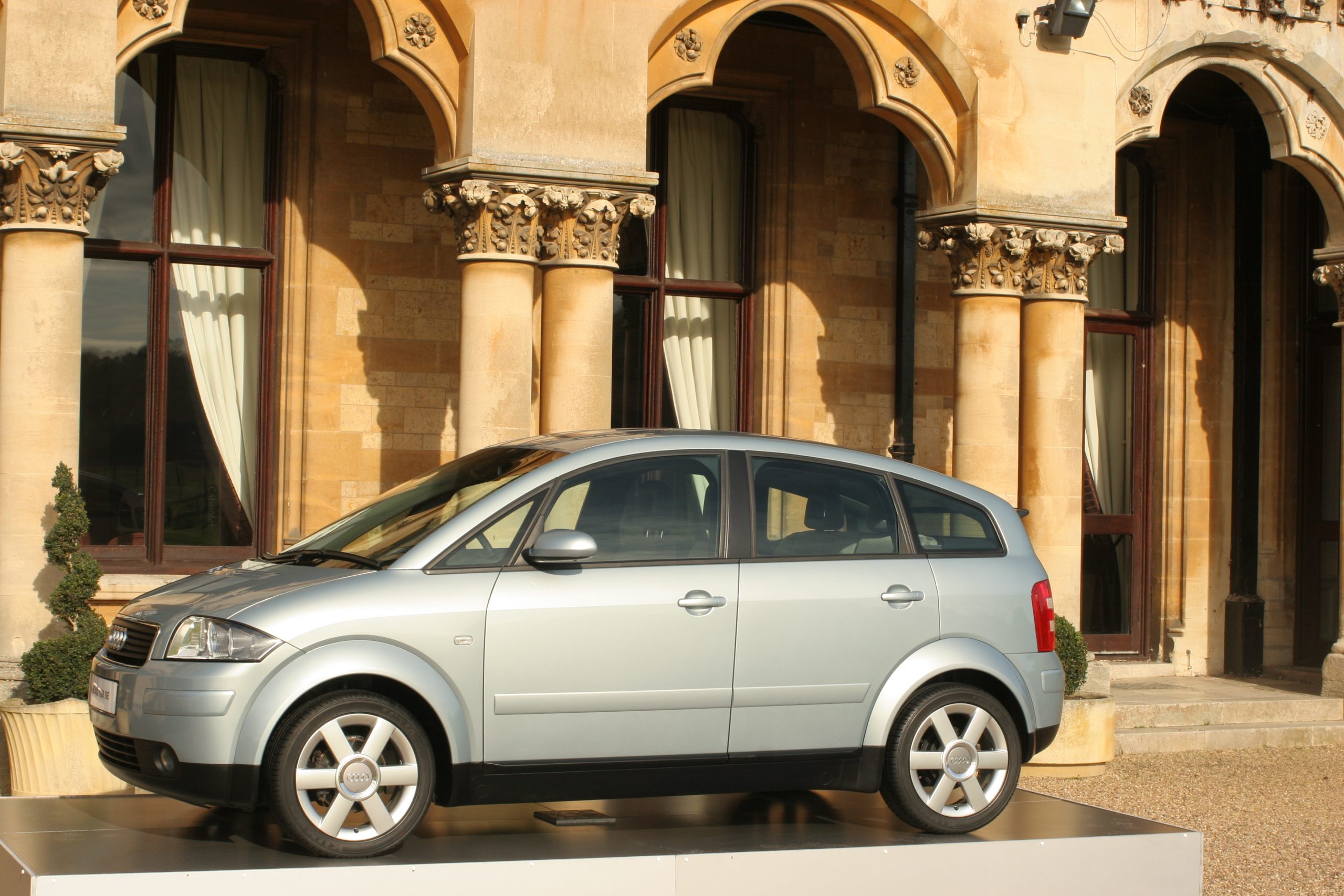
The production Audi A2 followed the prototype closely. At 990kg (2183lb) it is a good deal heavier than the Panhard. Like ECV3 it has a 3-cylinder engine, a 1.4litre diesel, with nearly twice the power of the Panhard. It is capable of 66mpg, has a top speed of 107mph, and its CO2 output of 116g/km is well below the threshold of 165g/km. The petrol one is even faster but is hard-pressed to reach 50mpg. Alas, like the aluminium Panhard, the aluminium space frame A2 costs 15 per cent more than other small cars. It is on a par with the ungainly Mercedes-Benz A2 but technically it is miles ahead. A good used one with refurbished mechanicals, re-engined if necessary can be fixed with readily available bits. Bolt them to the aluminium bodyshell and you have a highly satisfactory car for an everlasting retirement. They’re not expensive, there are lots of spares for them, they ride well and quietly. A great practical classic investment.
Published November 2002