
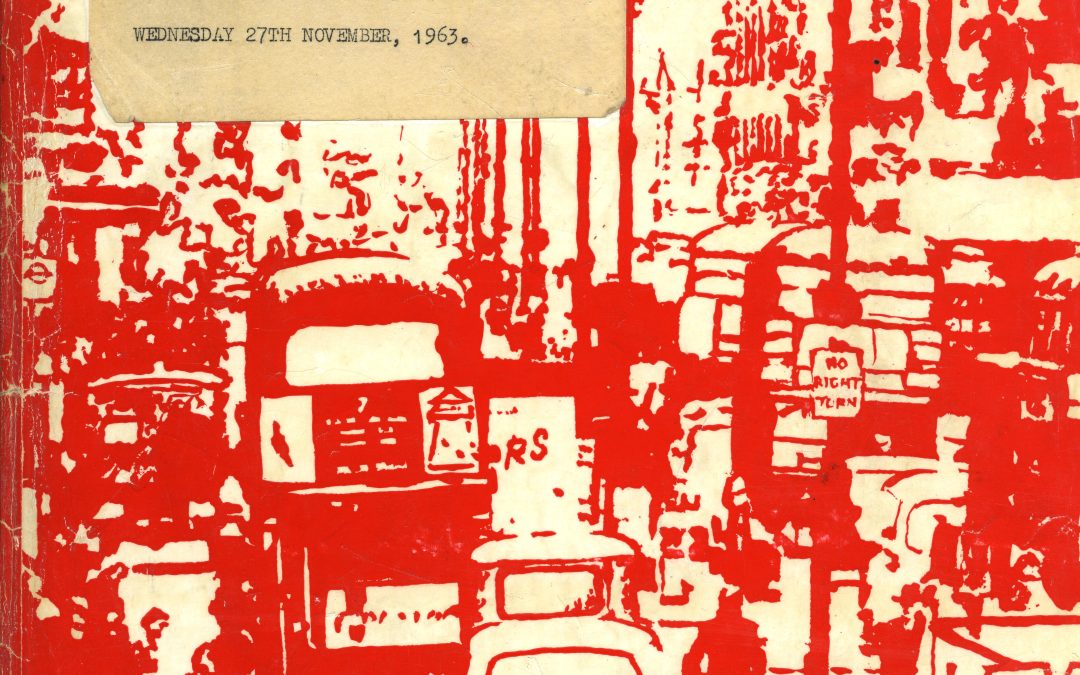
Traffic in Towns, Colin Buchanan. My 1963 review copy of Professor Buchanan’s report welcomed by The Motor as the most comprehensive document of its kind ever.
David Begg and the Commission for Integrated Transport
The Fleet Street Group of motoring correspondents is a shadowy outfit. It dates back to when national newspapers each had its own motoring correspondent. Changed days. They are nearly all freelance hacks now, yet the Fleet Street Group stuck to its title.
It also stuck to its principles. It accepts hospitality sparingly. Uniquely among motoring correspondent groups when it meets some notable over lunch at Rules, the oldest and one of the best restaurants in London, members pay. Members that is, not their newspapers, nor their guest. There may be no such thing as a free lunch, but it is sometimes fitting to reverse the custom under which somebody else picks up the tab, anticipating kindly copy.
Last week Professor David Begg was resigned to an unkind reception. The chairman of the Commission for Integrated Transport was ranged against ten motoring correspondents, whose views on integrated transport varied from profound scepticism to downright opposition. Yet by the time the banana soufflé arrived, each side had a cogent understanding of the other’s point of view. David Begg was even listening to what the despised “motoring lobby” had to say.
The group usually meets in the Edward VII room where, as Prince of Wales, he was accustomed to entertaining Lily Langtry and where a later Prince of Wales allegedly entertained journalists to discuss Diana Princess of Wales, or the Constitution or somesuch. The ambience invariably impresses the captains of industry, especially those from Munich or Stuttgart, who are the group’s staple fare.
This week we were in the Charles Dickens Room (it is a well-endowed building) and as usual the guest did not have an opportunity to make the most of Mr Rule’s splendid lunch. He was here to talk, and the debate had an edge to it. The Commission’s approach, seldom revealed in soundbites depicting it as anti-car, is that road pricing is only part of the approach to congestion. The key term is fiscal neutrality.
The Commission says the existing £5.7billion of road tax should be transferred to a new congestion charge. The government could take 12p off a litre of fuel, or else abolish Vehicle Excise Duty and take 2p off. Where there was no congestion there would be no charge. Two thirds of vehicles would never incur any charges at all but would still enjoy cheaper fuel. We pay extra for peak-rate telephone calls; less for using electricity at night, off-peak flights are cheaper. The principal has merit.
Fuel tax, which vexes Communitaire Brussels it seems almost as much as it does us, has not had much effect on reducing car use. Begg acknowledges that it is a blunt instrument, and drivers absorb it; it matters little to the wealthy or expense accounts. Car use this year went up by 3 per cent, more in each of the last five quarters than at any time since 1997. Van use has increased 16 per cent, road traffic by between 0.5 per cent, and 2.5 per cent a year for the last ten years. Since 1993 motorways have become a third busier even though road capacity increased only 8 per cent. Cars represent 80 per cent of traffic, light vans 11 per cent, and goods vehicles 6 per cent.
Under surveillance by a Global Positioning System and a great computer in the sky, the Commission wants to coax drivers not to travel at peak hours on busy roads. Granny in the Highlands (David Begg’s analogy not mine) would drive on uncongested roads using petrol at 55p a litre, but anybody car commuting at rush hour would incur London Mayor Ken Livingstone’s £5 a day.
The arithmetic is not easy. Cars were driven 97billion kilometres in the third quarter of 2002, and even with the biggest computer in the history of the world it is hard to see how the sums would be worked out and congestion bills rendered. Governments have never shown themselves capable of crunching such numbers with equanimity let alone accuracy.
“We have been rationing road space the way Stalinist governments used to ration bread,” says David Begg. “They rationed it by queuing.” Too true. The weak and the hungry suffered most, just as the burden of congestion is borne by those hapless commuters. Idealist? Probably. Begg is convinced the technology could be in place by 2010 but air traffic control computers that cannot deal with a handful of aeroplanes does not make me hopeful. Cars would be fitted with black boxes and Begg talks airily about how easily defaulters would be spotted.
Alas, look at the difficulties the authorities face catching licence-and-road-tax-dodgers now. The Commission’s report is an optimistic document. So was Professor Colin Buchanan’s Traffic in Towns of 1963. You just cannot see a government with the vision to grasp the simplicity of it. “Our starting point was that doing nothing was not an option,” Begg writes. My guess is that it is an option, a cheap and easy option, which the government will not exactly take. Yet not exactly not take.
Published November 2002